



Gum disease treatment depends on the stage. Early gingivitis often reverses with a professional cleaning and better home care. Periodontitis usually starts with scaling and root planing, a deep cleaning below the gum line, followed by regular maintenance visits. Surgery is reserved for pockets that stay deep. For gum disease treatment in Yardley, PA, call (215) 504-2400.
Key Takeaways
Your hygienist is probing around your teeth and calling out numbers. Two, two, three, four, five. Then she pauses, and your dentist walks in to talk about your gums. Suddenly the appointment feels a lot longer.
If that sounds familiar, take a breath. Gum disease is common, it’s treatable, and the plan is usually more manageable than people fear. The real question is which treatment fits your stage, and what each visit will involve.
That’s what this guide covers for patients in Yardley, PA. We won’t rehash symptoms here, since our post on spotting the signs of gum disease does that. Instead, we’ll walk through what happens next: how we choose a plan, what treatment looks like at each stage, how healing goes, and how to keep the disease from coming back.
Gum disease treatment is professional care that removes the bacteria and hardened tartar causing gum inflammation, then helps the gums heal and stay healthy. It ranges from a thorough cleaning for early gingivitis, to deep cleaning below the gum line for periodontitis, to surgery for stubborn cases. The goal is to stop the infection, protect the bone holding your teeth, and keep the disease from returning.
Before anyone talks treatment, we measure. A Langhorne patient who feels fine can still have deep pockets, because early gum disease is often painless. So we check several things at once.
| What We Check | What It Tells Us |
| Pocket depth | Healthy gums usually measure around 1 to 3 millimeters. Deeper readings suggest the gum has pulled away from the tooth |
| Bleeding when probed | Whether the gums are actively inflamed |
| X-rays or 3D imaging | How much bone surrounds each tooth |
| Tooth movement | Whether the support under a tooth has weakened |
| Health history | Conditions like diabetes, tobacco use, and medications that affect healing |
Put together, those findings point to a stage. The stage points to a plan.
Early gum disease, called gingivitis, can usually be reversed with a professional cleaning and consistent brushing and flossing. Periodontitis is different. Treatment can stop it and help your gums heal, but bone that’s already lost doesn’t regrow on its own. That’s why catching it early matters, and why ongoing care after treatment matters just as much.
Not every case needs the same level of care. A Newtown patient whose gums bleed at a routine cleaning may only need gingivitis care. Someone with deep pockets and bone loss needs a very different plan.
| Stage | What’s Happening | Typical Treatment | Goal |
| Gingivitis | Gum inflammation, no bone loss | Professional cleaning plus better home care | Return gums to health |
| Early to moderate periodontitis | Pockets forming, some bone loss | Scaling and root planing, sometimes added medication | Stop the infection and let gums tighten |
| Advanced periodontitis | Deep pockets, significant bone loss | Deep cleaning first, then surgery if pockets stay deep | Reduce pockets and protect remaining bone |
When surgery is needed, your plan may include options like pocket reduction, flap surgery, bone grafting, or gum grafting. Your pocket depths and bone levels decide which one fits. If your case calls for a periodontist, we’ll tell you plainly and explain why. Our periodontal treatment page explains how we approach gum care, and our earlier post covers what periodontal disease is if you want the background.
According to the American Academy of Periodontology, scaling and root planing, a deep cleaning below the gum line, is often a first step in treating periodontal disease. You can read their overview in the AAP’s periodontal treatment guide.
Picture a Morrisville patient nervous about her first deep cleaning. Here’s what actually happens, step by step:
Because the work is detailed, it’s often done in sections of the mouth, which can take more than one visit.
The area is numbed, so a deep cleaning shouldn’t hurt while it’s happening. Afterward, your gums may feel tender and your teeth may be sensitive to hot and cold for a few days. Many people manage this with over-the-counter pain relievers taken as directed. If pain is severe or keeps getting worse, call us.
Let’s Talk Strategy: Not sure where your gums stand? Book an exam and we’ll measure your pockets, review your imaging, and explain what we find in plain language before recommending anything. |
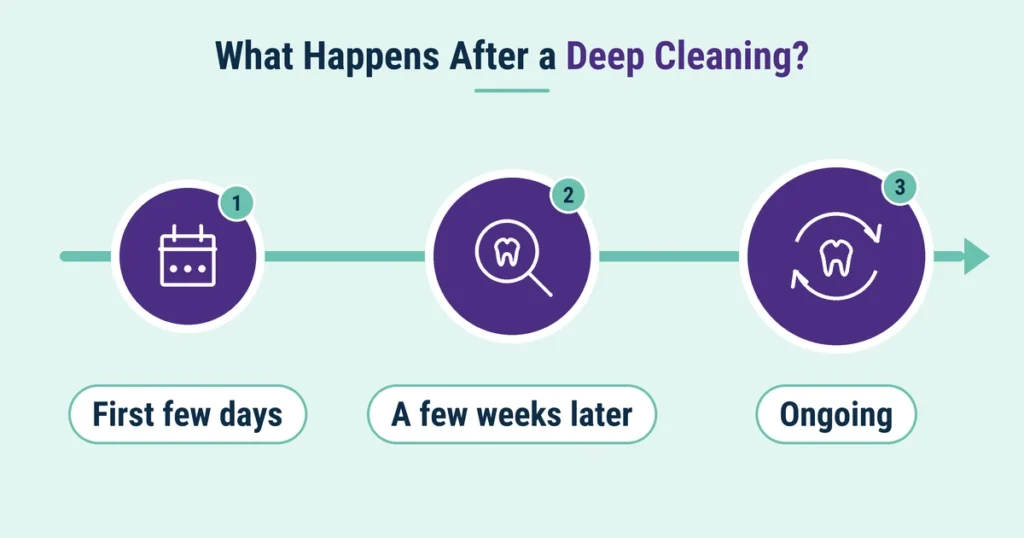
Healing is usually quieter than patients expect. A Levittown patient might feel tender for a few days, then notice the bleeding when brushing starts to fade. That’s a sign things are moving in the right direction.
| Timeframe | What to Expect | What Helps |
| First few days | Tender gums, possible sensitivity | Soft foods, gentle brushing, rinse only as directed |
| A few weeks later | A re-check where we measure your pockets again | Keep up your home care |
| Ongoing | Maintenance cleanings | Keep every appointment |
That re-check is the moment of truth. If pockets have shrunk and bleeding has calmed, the treatment worked. If some areas stay deep, we talk through next steps together.
It depends on the stage. Gingivitis often improves within a couple of weeks of a professional cleaning and better home care. Periodontitis takes longer, since deep cleaning may be split across visits, followed by a re-check and ongoing maintenance. Gum disease is managed over time, not cured in a single appointment, so plan on long-term care.
Most patients hope surgery never comes up, and for many it doesn’t. Deep cleaning is often enough to bring gum disease under control. A Southampton patient who responds well may never need more.
Some cases do need additional care. Surgery usually enters the conversation when:
Lasers are one tool some dentists use to treat gum disease, usually alongside traditional care. Evidence on whether they outperform scaling and root planing is mixed, and deep cleaning remains the common first step. The right choice depends on your stage and your dentist’s approach, so ask what’s recommended for your gums and why.
Related Service: Want to see how we approach gum care from the first exam onward?
Our periodontal page explains what to expect, from evaluation to long-term maintenance.
Explore periodontal treatment
Here’s the part many patients don’t hear enough. Treatment controls the infection, but the bacteria want to come back. A Bensalem patient who skips maintenance visits and lets plaque build up again can end up right where she started.
After treatment for periodontitis, cleanings usually need to happen more often than the standard twice a year. Many follow a schedule such as every three to four months, though your dentist sets the interval based on how your gums respond. Our post on how often to get a dental cleaning explains the general baseline.
Your daily checklist:
For a daily routine that supports your gums, see our best daily habits for good oral health.
Related Content: Not sure you’re cleaning between your teeth the right way?
Technique matters more than effort, and our guide walks you through it.
Read how to floss correctly
Patients from Yardley, Lower Makefield, and across Bucks County tell us they want someone who explains the plan before treatment starts. Our office is built around one-on-one time with the doctor and hygienists, not a rushed, high-volume schedule, and we use 3D imaging to see the bone around your teeth. Our practice holds a 4.9 out of 5 rating across more than 400 Google reviews.
We also tell you plainly when a case needs more than we can offer in our office, and we’ll explain your options so you aren’t left guessing. Whether you’re starting with a cleaning or a bigger plan, you’ll know what comes next.
Gum disease sounds scary, but the path through it is clear. We measure, we match the treatment to your stage, we check how your gums respond, and we keep you on a maintenance plan so the disease stays quiet.
What matters most? Acting early, showing up for the re-check, and keeping up your maintenance visits. Do those three things and you give your gums the best chance to stay healthy.
Here’s your next step. If your gums bleed, feel tender, or a dentist has mentioned pockets, don’t wait for it to get worse. Whether you’re in Yardley or anywhere in Bucks County, we’re ready to take a look and walk you through your options. Call (215) 504-2400 or book an appointment today.
Yes. We examine your gums, measure pocket depths, review imaging, and build a treatment plan around your stage. Many patients start with a professional cleaning or deep cleaning and a re-check a few weeks later. If your case needs a periodontist, we’ll say so plainly and explain why. Early treatment is usually simpler. Call (215) 504-2400 to schedule a gum evaluation.
Cost depends on the stage of your gum disease, how many areas of your mouth need treatment, whether surgery is involved, and what your insurance covers. Deep cleaning, follow-up visits, and maintenance cleanings may all be part of the plan. We review your treatment plan, costs, and coverage before we begin, so you know what to expect. Our insurance page explains general coverage.
A regular cleaning removes plaque and tartar from the visible parts of your teeth and a little beneath the gum line in healthy mouths. A deep cleaning, called scaling and root planing, goes below the gum line into the pockets and smooths the root surfaces so gums can heal. It’s usually done with numbing, and sometimes in sections across more than one visit.
Swollen, inflamed gums usually calm down and tighten once the infection is controlled. Gums that have receded generally don’t grow back on their own, though. If recession is a concern, a gum graft may be an option, and we’ll tell you whether it fits your case. Catching gum disease early gives you the best chance of keeping the gum line you have.
After treatment for periodontitis, most patients need cleanings more often than the usual twice a year. Many follow a schedule such as every three to four months, though your dentist will set the interval based on your pocket depths and how your gums respond. These visits keep bacteria from rebuilding and let us catch changes early.
Yes, it can. Treatment controls the infection, but bacteria can rebuild if plaque builds up again or maintenance visits get skipped. Smoking and uncontrolled diabetes also make gum disease harder to keep in check. The encouraging part is that regular maintenance visits and steady daily care give you the best chance of staying stable, and we’ll catch early changes at your check-ups.
Yes. Patients come to us from Langhorne, Newtown, Morrisville, Levittown, Southampton, and across Bucks County. If you’re unsure whether our Yardley office works for you, call (215) 504-2400 before you book. We’ll answer questions about the exam, what treatment may involve, and how many visits to expect, so you can plan around your schedule.
Call (215) 504-2400 or book an appointment online, and tell us about any bleeding, swelling, or loose teeth you’ve noticed. Bring a list of your medications and mention conditions like diabetes. We’ll measure your gums, review imaging, and explain what we find in plain language before recommending any treatment. You’ll leave knowing your options.
"My mission is to always provide extraordinary dental care in a compassionate setting. At Yardley Dental Arts, quality is key! We are NOT a high volume, high turnover office. We are patient centric office. Our practice model allows for concierge service and exclusive one on one time with the doctor and the hygienists. We pride ourselves on using premier materials, labs and the latest in dental technology including our GREEN CT 3D SCANNER, delivering high quality images at a fraction of the radiation as compared to the standard. This allows for fully customized treatment plans focusing on your specific needs and comfort level.
It’s a pleasure to serve you and your family for your comprehensive dental needs. Every one of us is passionate about what we do, and it shows! I look forward to meeting you."
